
For Rural Healthcare, Energy Resilience is Care Continuity
SUMMARY
OUTLINE
ENGAGE


Why Energy Strategy Belongs in the Rural Healthcare Resilience Plan
In rural healthcare, an outage is not just an inconvenience. It can become a clinical event. Reliable power supports emergency departments, procedure rooms, medication and vaccine refrigeration, HVAC, IT systems, communications, water, and infection control. When those systems are interrupted, the ability to deliver care can be interrupted as well. For critical access hospitals, rural clinics, skilled nursing facilities, and community care hubs, energy resilience is directly tied to patient safety, operational continuity, and community access to care.
Yet rural healthcare leaders often face a difficult reality: the infrastructure needs are real, but the capital and staffing capacity to address them may be limited. Aging buildings, deferred maintenance, generator testing requirements, utility cost volatility, and lean facilities teams all compete with broader financial pressures. Even when modernization is clearly needed, traditional capital-funded projects may be hard to prioritize.
Shift the Conversation from “What Equipment Should We Buy?” to “What Outcomes Do We Need to Protect Care?”
Energy as a Service (EaaS) offers another option. Through an EaaS model, rural healthcare organizations can pursue energy upgrades through a performance-oriented service agreement rather than a large upfront purchase. Solutions may include efficiency improvements, lighting, controls, battery storage, onsite generation, backup power modernization, monitoring, and ongoing operations and maintenance.
Done well, EaaS helps shift the conversation from “What equipment should we buy?” to “What outcomes do we need to protect care?” For rural healthcare, those outcomes include uptime, cost predictability, reduced maintenance burden, and confidence that critical services can continue when the grid is under stress.
Rural realities matter here. The U.S. Government Accountability Office (GAO) has documented that rural hospital closures reduce access to services and can force patients to travel farther for care, making continuity and resilience not just operational issues but access issues. At the same time, rural hospitals face intensified financial pressure; recent analysis from The Chartis Center for Rural Health describes a growing share operating in the red. (U.S. GAO, 2020; Chartis Center for Rural Health, 2026) Even if your facility is stable today, your community’s resilience depends on your ability to stay open tomorrow.
Rural Healthcare Is Uniquely Impacted
The rural grid and the rural facility are both “long-tail” (rare, high-impact events) problems. Rural outages are not only about frequency; they’re about restoration time and resource constraints. The U.S. Energy Information Administration (EIA) tracks reliability using the System Average Interruption Duration Index (SAIDI) and the System Average Interruption Index (SAIFI), and separates “major-event days” from normal operations because a facility’s greatest outage risk may come from a few severe events, exactly when rural hospitals have the least margin for failure. (EIA, n.d.) According to EIA’s Electric Power Annual 2024, U.S. electricity customers experienced an average of 11 hours of power interruptions in 2024, with major events accounting for 80% of the hours without electricity. While this is a systemwide customer average rather than hospital-specific data, it underscores why rural healthcare facilities should plan for long-duration, high-impact outage scenarios rather than relying on typical outage averages. (EIA, 2025)
For rural hospitals and clinics, the operational consequences are amplified by:
- Fewer backup redundancies
- Older electrical infrastructure and deferred maintenance
- Limited onsite engineering coverage
- Supply chain fragility during regional disasters (fuel delivery, parts, contractor availability)
The U.S. Department of Health and Human Services (HHS), Assistant Secretary for Preparedness and Response (ASPR), Technical Resources, Assistance Center, and Information Exchange (TRACIE) and Federal Emergency Management Agency (FEMA) both provide healthcare-specific guidance for power outages, highlighting the need to identify critical systems, plan for fuel and staffing, and coordinate with community partners. (ASPR, n.d.; FEMA, 2020)
Why Energy Is A Clinical And Financial Issue In Rural Care
Once rural healthcare leaders identify outage risk, the next question is how to reduce the size and cost of the resilience challenge. That starts with understanding the facility’s energy use.
Hospitals are energy-intensive buildings. ENERGY STAR benchmarking shows that hospital energy use intensity varies widely from less than 100 to more than 1,400 kBtu per square foot across hospitals, indicating that many facilities have both high exposure and real efficiency headroom. (EPA, 2015) DOE’s Better Buildings program notes that healthcare accounts for a disproportionate share of commercial energy use, underscoring why energy strategy is now part of core operations. (DOE, n.d.-b)
EaaS is one of the most practical tools for responding, especially for rural organizations with limited capital and bandwidth. Done well, EaaS can convert a complicated bundle of upgrades (efficiency _ onsite power + controls + maintenance) into a performance-backed service with predictable payments.
Clinical risk often begins with non-obvious loads, such as HVAC, IT, and refrigeration. Energy planning isn’t just “keeping the lights on”; it’s protecting care pathways. If energy fails, care pathways fail, so energy strategy belongs on the same dashboard as quality, finance, and emergency preparedness. (FEMA, 2020)
Emergency preparedness isn’t optional. CMMS requires emergency planning, policies, communication, and training. If generators are part of the plan, backup power must support operational needs, including HVAC where required. (CMS, n.d.; ASPR, 2019)
Outage Duration: Conditions vs Major Events
Exhibit A: Major events accounted for most average outage duration in 2024, underscoring the need to plan for long-duration scenarios.

Source: U.S. Energy Information Administration, Electric Power Annual 2024 / Today in Energy, Dec. 1, 2025. Represents U.S. utility-customer average; not healthcare-specific.
What is Energy as a Service
EaaS is a contract model in which an energy partner or Energy Services Organization (ESCO) designs, finances through a financial partner, installs, operates, and maintains energy improvements. The healthcare organization pays for the service over time, often based on agreed-upon outcomes such as savings, availability, resilience, or performance.
The American Council for an Energy-Efficient Economy (ACEEE) describes service-based models in which customers repay through periodic fees tied directly or indirectly to realized savings, often with the provider taking on performance risk. (ACEEE, 2019)
Many EaaS deals resemble a family of “as-a-service” structures:
- Energy Service Agreements (ESAs) for efficiency (provider may own equipment during term) (DOE, n.d.-a)
- Power Purchase Agreements (PPAs) for on-site generation (pay per kWh)
- Availability/resilience contracts (pay to keep backup power ready and reliable), so your critical services can keep running during an outage. You are not paying for the electricity you use. You are paying for readiness and performance.
In practice, rural healthcare often benefits from bundling: efficiency, controls, backup modernization, onsite generation, storage, microgrid controls, and operations and maintenance (O&M).
Five Outcomes to Demand from EaaS
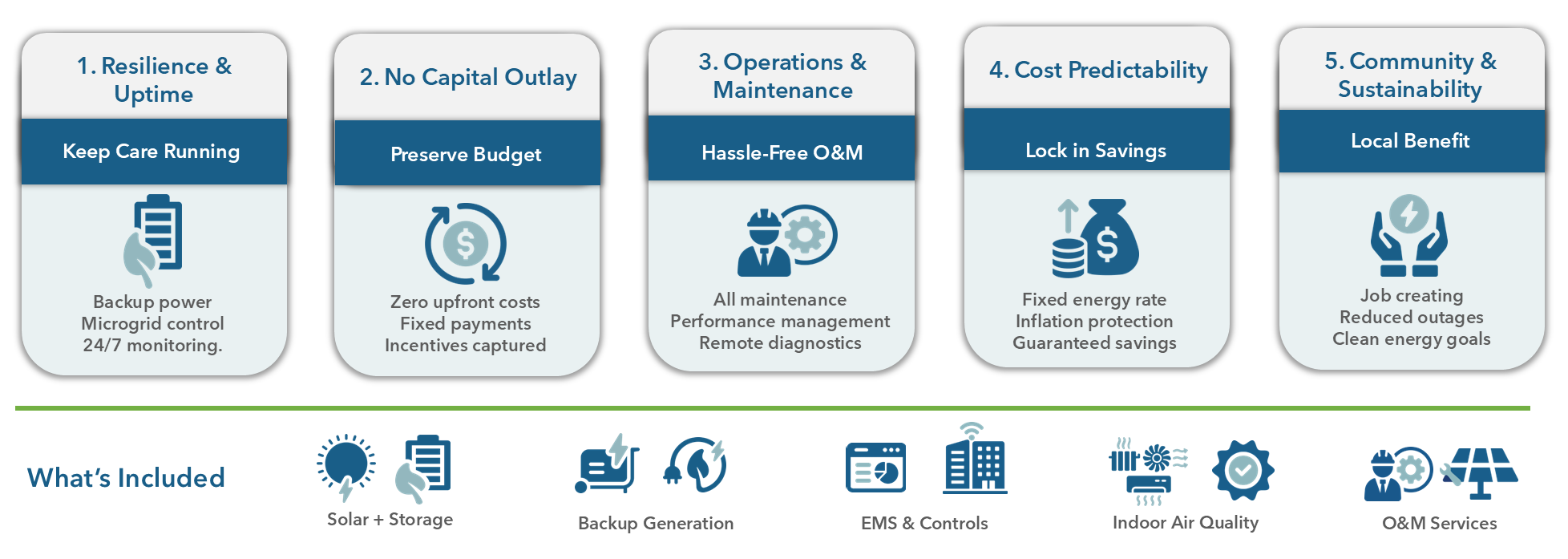
EaaS should be evaluated by the outcomes it delivers, not by the equipment included in the package. For rural healthcare, those outcomes are practical: keep care running, preserve capital, reduce maintenance burden, improve cost predictability, and support community resilience. Solar, storage, backup generation, controls, indoor air quality improvements, and O&M services are not standalone goals; they are tools that should be combined only where they support measurable care-continuity and financial objectives.
This outcomes-based view is especially important for rural hospitals and clinics because capital, staffing, and outage-response resources are often limited. A strong EaaS program should define what critical loads must remain available, what performance commitments are required, who is responsible for maintenance and monitoring, and how savings or uptime will be measured. When structured well, EaaS can help rural providers modernize infrastructure while keeping the focus where it belongs: reliable care, predictable cost, and community access.
More than 40% of rural hospitals operate in the red; 417 are vulnerable to closure. (Chartis Center for Rural Health, 2026)
Exhibit B: EaaS is best understood as contracting for energy outcomes, such as uptime, cost savings, and operational performance, rather than purchasing individual assets. Instead of buying equipment, customers procure a performance-guarantee portfolio that may include generation, storage, controls, and ongoing support.
What an EaaS Project Includes
1. Reduce the load you must back up
|
3. Add onsite distributed energy resources
NREL emphasizes defining resilience objectives and designing accordingly, rather than starting with a favorite technology. (NREL, 2019) |
2. Prioritize and shape loads before adding supply
|
4. Controls, monitoring, and cybersecurityMicrogrids and building controls are connected systems. The National Institute of Standards and Technology (NIST) Operational Technology (OT) security guidance explicitly includes building automation systems, which is directly relevant when your energy systems become more software-defined. (NIST, 2023) |
The most resilient load is the one you do not need to back up.
Shrink, Shape, Supply, and Secure
EaaS isn’t a single technology; it’s an engineered service built from four buckets.
Hospitals should approach energy resilience by starting with clinical need, not equipment selection. The goal is not to back up every square foot of a facility equally; it is to identify the services that must continue during an outage and the electrical, mechanical, IT, and environmental systems that support them. That distinction is especially important for rural healthcare organizations, where capital is limited, facilities teams are lean, and prolonged outages can quickly become care-continuity events.
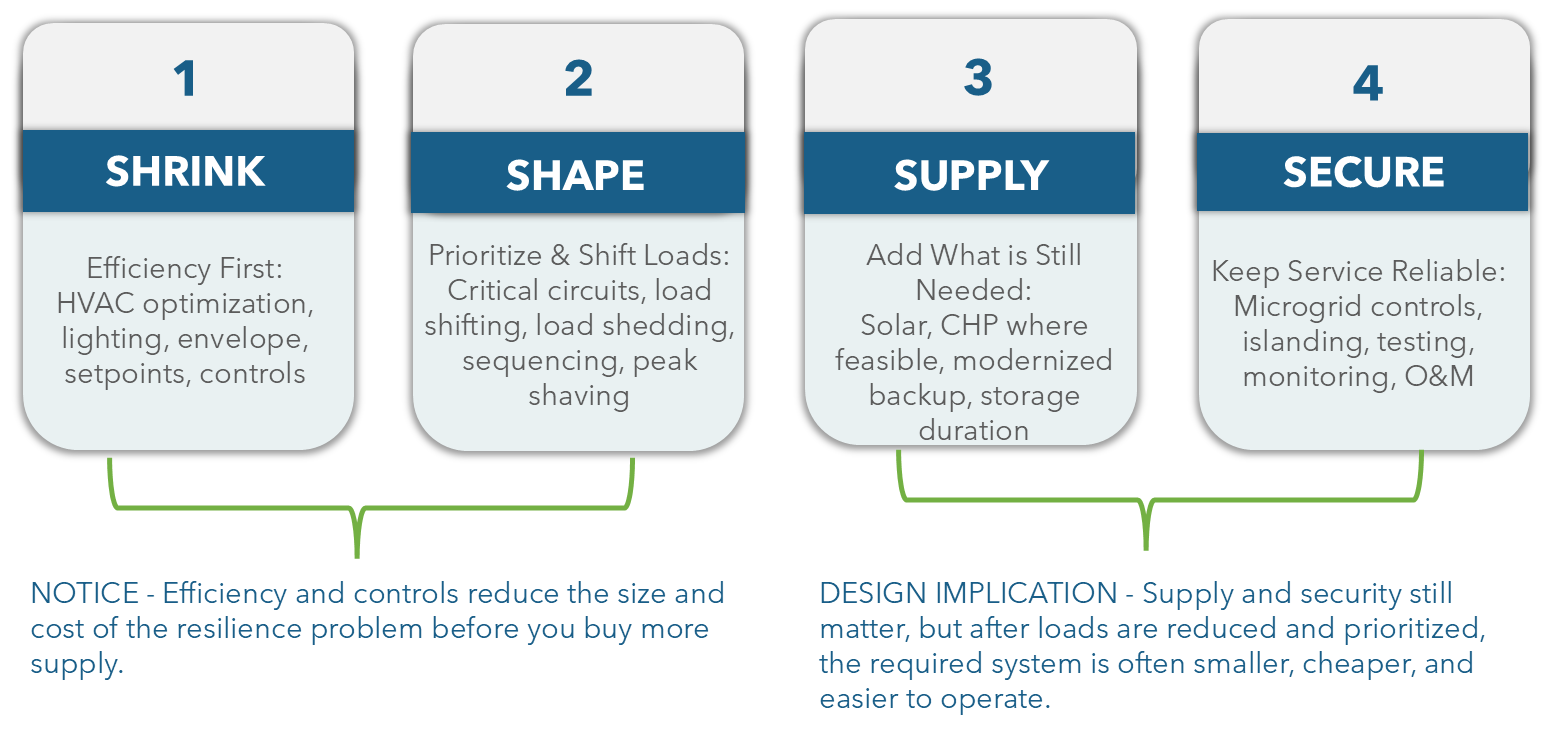
The Shrink, Shape, Supply, and Secure model provides a practical sequence. First, reduce avoidable energy use. Then prioritize and manage loads based on clinical importance. Next, size generation, storage, and backup systems around the remaining needs. Finally, secure performance through controls, monitoring, testing, cybersecurity, and O&M. Following this order helps hospitals avoid overbuilding, reduce cost, and focus resilience investments on the loads that matter most to patient care.
Exhibit C: Efficiency and controls reduce the size (and cost)) of the resilience problem. The cheapest resilience is the resilience you don’t need; reduce and prioritize loads before adding supply.
Three Pathways to Modernize Rural Healthcare Energy Systems
Table 1: EaaS shifts more performance and maintenance responsibility to the provider but requires stronger contract discipline. EaaS is not “better” than EPC or capex by default, but it can be uniquely well-suited to rural constraints when structured with clear performance and exit options.
Dimension |
Traditional Capex / Owner Purchase |
EPC/ESPC (Performance Contract) |
EaaS (Service Model) |
Upfront Capital |
High | Low-to-moderate (often financed) | Low-to-none |
Who owns assets during the term |
Owner | Usually owner | Often provider (varies) |
Performance guarantee |
Depends | Typically, energy savings guarantee (EPA, n.d.-b) | Often savings and uptime (contracted) |
O&M burden |
Owner | Shared/vaies | The provider often takes primary responsibility |
Best for |
Strong capex & facilities staff | Efficiency-heavy retrofits | Bundled efficiency & resilience & controls & limited staff |
Key risk |
Deferred maintenance, staff burden | M&V complexity, scope creep | Contract lock-in, interoperability, vender dependence |
The right choice depends on capital constraints, risk tolerance, and internal O&M capacity.
What to Demand Contractually
Archetypes and the Critical-Load “Minimum Viable Microgrid”
Start with what must stay on, then build outward
Table 2: The smallest viable resilience package is often storage + controls + targeted circuits, not a full campus rebuild. The best rural EaaS scopes are “clinical load first” and avoid overbuilding.
Rural Healthcare |
Critical Loads to Keep On |
Right-Sized Resilience Package |
Why This is Often Enough |
Scale Later Only if Needed |
Critical Access Hospital |
ED, med-gas support, nurse stations, med refrigeration, core IT, selected lighting | Battery, controls, targeted critical-load panel, modernized generator tie-in | Fast ride-through, cleaner transfers, lower fuel dependence, no need to island every wing | Add solar or expand circuits after proving performance |
Rural clinic / FQHC |
Vaccines, diagnostics, exam rooms, broadband, small HVAC zone, lighting | Battery, controls, selective circuits | Often, the lowest-cost path to continuity without a full site rebuild | Add solar when the daytime load profile supports it |
Long-term care / skilled nursing |
Life-safety systems, med carts, kitchen essentials, corridor lighting, cooling zones | Battery, controls, backup, modernization, load shedding | Protects vulnerable residents while focusing capital on the highest-risk loads | Expand duration only where the outage history justifies it |
Community hospital campus |
Surgery support, pharmacy, imaging support loads, IT backbone, air handling for key areas | Targeted storage, controls, and generation on essential feeders | Resilience improves most when the clinical circuits are prioritized instead of rebuilding the full campus | Broader microgrid buildout should follow phased operational results |
Use Cases: Right-Sizing EaaS for Different Rural Healthcare Settings
The table above shows the planning logic. The examples below translate that logic into common rural healthcare settings
Economics and Contracting
Measurement and Verification (M&V)
If payments depend on savings, define:
- Baseline period (e.g., 24-36 months)
- Adjust factors (eather, occupancy, service line changes)
- What counts as savings (kWh, kW demand, fuel, maintenance, avoided rentals)
- Independent verification and audit rights
EPA’s ESPC overview underscores the centrality of guaranteed savings and performance accountability. (EPA, n.d.-b)
Service Level Agreements (SLAs) / uptime guarantee (resilience is a service, so specify it)
For rural healthcare, a serious EaaS contract should define:
- Critical circuits and kW served
- Minimum runtime under defined scenarios
- Response time for faults
- Maintenance/testing schedule
- Penalties or remedies for non-performance
Use FEMA and ASPR TRACIE outage-planning guidance as your “requirements backbone” to translate planning needs into contract specifications. (ASPR, n.d.; FEMA, 2020)
Pricing structures
- Fixed service fee (bundled, predictable)
- Shared savings (provider paid from verified savings)
- Availability payment (pay for guaranteed capacity and uptime)
- Hybrid (often best: efficiency supports resilience economics)
In performance-based models, pricing is structured to align payments with the value delivered. The U.S. EPA notes that energy savings performance contracting is designed to deliver savings “at least equal to the amount of the payments needed to finance the improvement(s),” and may use a “shared savings” approach. Likewise, FERC explains that capacity markets pay not for energy produced, but for “the ability to produce power when needed,” a useful parallel to EaaS contracts that pay for guaranteed uptime and standby capability. (EPA, n.d.-b; FERC, 2025)
Annual Cost & Outage Risk Exposure
Exhibit D: EaaS can reduce utility costs and reactive maintenance while adding a service fee that buys defined resilience outcomes (coverage, uptime, response time). The economic case is often risk-adjusted: fewer emergency rentals, fewer spoiled medications, fewer canceled procedures, and less risky labor.
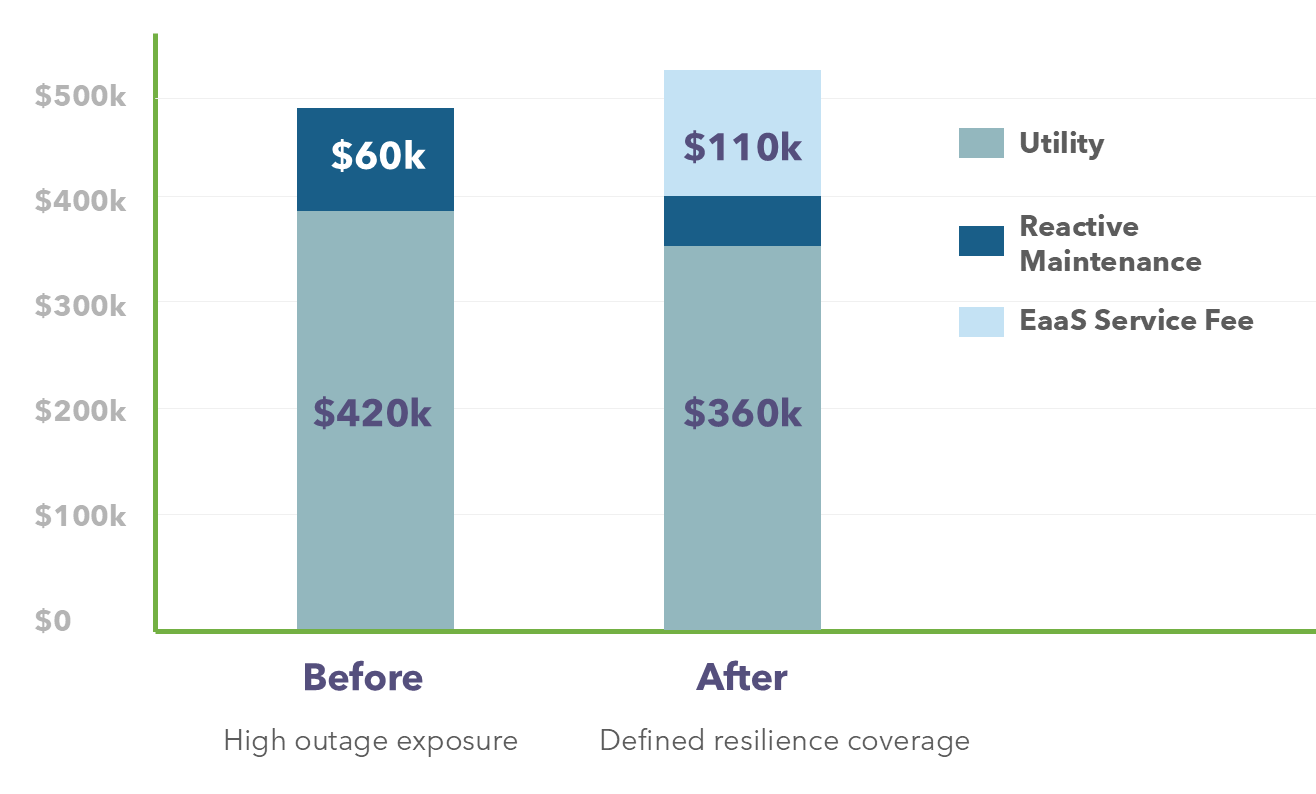
Illustrative scenario only; actual economics vary by facility, utility tariff, scope, incentives, and contract structure.
Evaluate EaaS in 8 Steps
Move from clinical priorities to technical scope, then to economics, procurement, and governance.
Exhibit E: A repeatable process that works for a CAH, clinic network, or LTC facility. The first decision is not vendor selection; it’s defining critical loads and acceptable downtime.
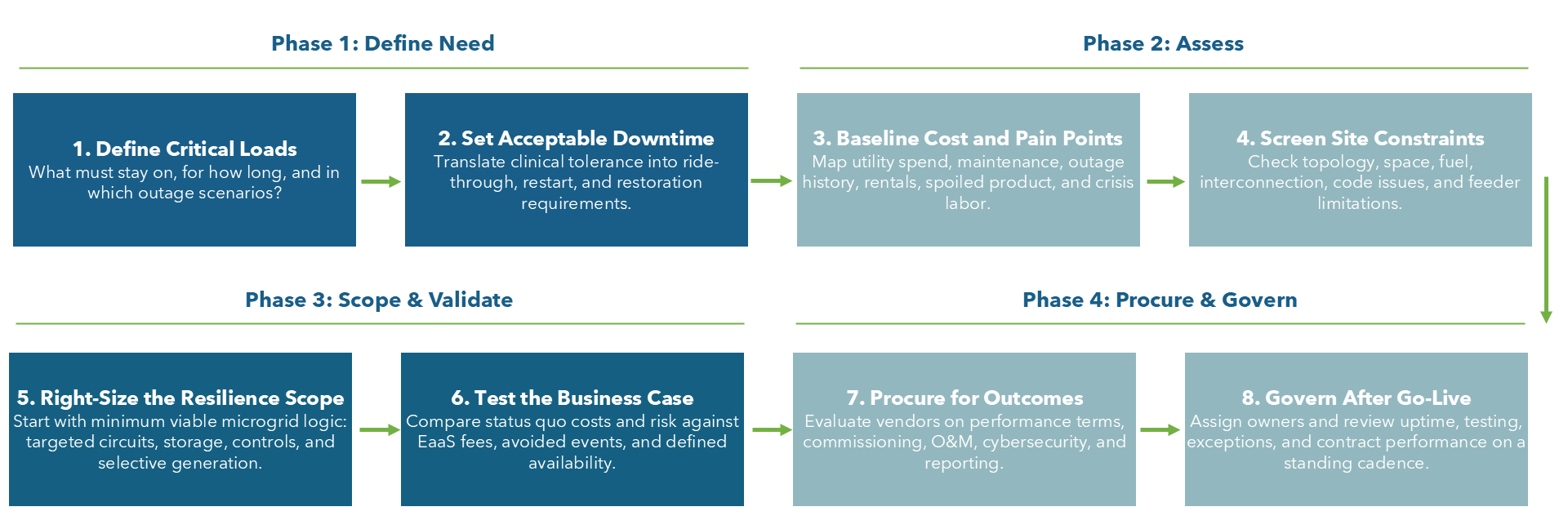
This order helps avoid overbuilding and weak contracts.
Conclusion and Action Plan
Next 30 Days
- Build a one-page critical load list and downtime tolerance map.
- Convene a 60-minute cross-functional meeting (CFO, Facilities, IT, Clinical, Compliance).
- Pull 24 months of utility bills and any interval data.
- Inventory generators, ATS, switchgear age/condition, and last test outcomes.
- Choose your procurement lane (capex, EPC/ESPC, EaaS) and draft an evaluation rubric.
- Shortlist partners and request concept proposals that include resilience SLAs and M&V plans.
- Identify complementary funding sources and assign someone to verify current eligibility.
Final key takeaway: Rural healthcare organizations do not need to solve every infrastructure challenge at once. But they do need to know which clinical loads must remain available, for how long, and under what outage conditions. Energy resilience is not a facilities side project; it is part of the care-continuity plan. EaaS can be one credible pathway when the contract is built around measurable outcomes, operational accountability, and governance.
Authors
References
References:
American Council for an Energy-Efficient Economy. (2019, February 7). Emerging opportunities: Energy as a service. https://www.aceee.org/topic-brief/eo-energy-as-service
Centers for Medicare & Medicaid Services. (n.d.). Emergency preparedness rule. U.S. Department of Health & Human Services. Retrieved March 18, 2026, from https://www.cms.gov/medicare/health-safety-standards/quality-safety-oversight-emergency-preparedness/emergency-preparedness-rule
Centers for Medicare & Medicaid Services. (2023, March 31). QSO-23-11-LSC: Categorical waiver—Health care microgrid systems (HCMSs). U.S. Department of Health & Human Services. https://www.cms.gov/files/document/qso-23-11-lsc.pdf
Chartis Center for Rural Health. (2026, February 10). 2026 rural health state of the state: Rural healthcare challenges deepen as the Rural Health Transformation program ramps up. Chartis. https://www.chartis.com/insights/2026-rural-health-state-state
Federal Emergency Management Agency. (2020, July). Healthcare facilities and power outages. U.S. Department of Homeland Security. https://www.fema.gov/sites/default/files/2020-07/healthcare-facilities-and-power-outages.pdf
Federal Energy Regulatory Commission. (2025, April 1). Understanding wholesale capacity markets. https://www.ferc.gov/understanding-wholesale-capacity-markets
National Institute of Standards and Technology. (2023, September). Guide to operational technology (OT) security (Special Publication 800-82 Rev. 3). U.S. Department of Commerce. https://csrc.nist.gov/pubs/sp/800/82/r3/final
National Renewable Energy Laboratory. (2019). Microgrids for energy resilience: A guide to conceptual design and lessons from defense projects (NREL/TP-7A40-72586). U.S. Department of Energy. https://docs.nrel.gov/docs/fy19osti/72586.pdf
U.S. Department of Energy. (n.d.-a). Energy service agreements (ESAs). Better Buildings Solution Center. Retrieved March 18, 2026, from https://betterbuildingssolutioncenter.energy.gov/sites/default/files/news/attachments/RILA%20ESA%20Primer.pdf
U.S. Department of Energy. (n.d.-b). Healthcare. Better Buildings Solution Center. Retrieved March 18, 2026, from https://betterbuildingssolutioncenter.energy.gov/sectors/healthcare
U.S. Department of Health & Human Services, Office of the Assistant Secretary for Preparedness and Response. (n.d.). Planning for power outages: A guide for hospitals and healthcare facilities. ASPR TRACIE. Retrieved March 18, 2026, from https://asprtracie.hhs.gov/technical-resources/resource/4033/planning-for-power-outages-a-guide-for-hospitals-and-healthcare-facilities
U.S. Department of Health & Human Services, Office of the Assistant Secretary for Preparedness and Response. (2019, February 26). CMS emergency preparedness rule generator requirements (ASPR TRACIE technical assistance). https://files.asprtracie.hhs.gov/documents/aspr-tracie-ta-cms-ep-rule-generator-requirements-2-26-19.pdf
U.S. Energy Information Administration. (2025, December 1). Hurricanes in 2024 led to the most hours without power in the United States in 10 years. Today in Energy. https://www.eia.gov/todayinenergy/detail.php?id=66744
U.S. Energy Information Administration. (n.d.). Reliability metrics (SAIDI and SAIFI). Electric Power Annual. Retrieved March 18, 2026, from https://www.eia.gov/electricity/annual/html/epa_11_03.html
U.S. Environmental Protection Agency. (2015, January 29). Energy use in hospitals (DataTrends). ENERGY STAR. https://www.energystar.gov/sites/default/files/tools/DataTrends_Hospital_20150129.pdf
U.S. Environmental Protection Agency. (n.d.-b). Performance contracting and energy service agreements. Retrieved March 18, 2026, from https://www.epa.gov/statelocalenergy/performance-contracting-and-energy-service-agreements
U.S. Government Accountability Office. (2020, December 22). Rural hospital closures: Affected residents had reduced access to health care services (GAO-21-93). https://www.gao.gov/products/gao-21-93
FAQs
1. What is Energy as a Service, or EaaS?
EaaS is a service-based contract model where an energy partner designs, finances, installs, operates, and maintains energy improvements. Instead of making a large upfront equipment purchase, a healthcare organization pays over time for defined outcomes such as savings, uptime, resilience, or performance.
2. Why does energy resilience matter for rural healthcare?
For rural healthcare facilities, a power outage can quickly become a care-continuity issue. Reliable energy supports emergency departments, procedure rooms, medication and vaccine refrigeration, HVAC, IT systems, communications, water, and infection control. When those systems are disrupted, patient care and community access can be disrupted too.
3. Does every rural healthcare facility need a full microgrid?
Not necessarily. The document emphasizes a “critical-load first” approach. Many rural facilities can start with a right-sized package such as battery storage, controls, targeted critical-load panels, selective circuits, or generator modernization before expanding to a broader microgrid.
4. What should rural healthcare leaders demand in an EaaS contract?
A strong EaaS contract should define the critical loads to be served, minimum runtime during outages, response times, testing and maintenance schedules, measurement and verification, uptime expectations, and remedies if performance commitments are not met.
5. What is the first step in evaluating EaaS?
The first step is to define the clinical loads that must remain available and the acceptable downtime for each. From there, leaders can assess utility costs, outage risks, existing infrastructure, site constraints, procurement options, and the business case for a right-sized resilience solution.