
The On-Ramp to Decarbonization for Local Government

SUMMARY
OUTLINE
ENGAGE



Exhibit A
The Central Thesis
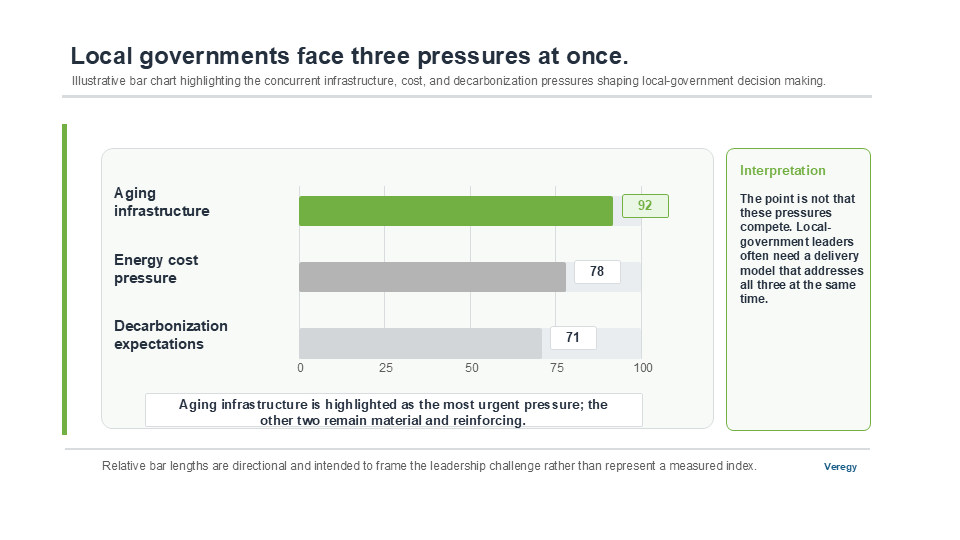
For many local governments, ESPC is the most practical mechanism for turning climate goals into implemented projects.1 It allows public owners to bundle efficiency, electrification, on-site generation, storage, and infrastructure renewal into a single investment program repaid from guaranteed savings, rather than waiting for new taxes, deferred capital appropriations, or fragmented grant cycles.
That matters because the public-sector decarbonization challenge is usually not the lack of identified opportunities. The challenge is that most opportunities sit across multiple facilities, departments, and budget silos, with different replacement cycles and different funding constraints. ESPC creates a portfolio-based framework that can move these investments from aspiration to execution.
Exhibit B
Why Conventional Capital Planning Underdelivers
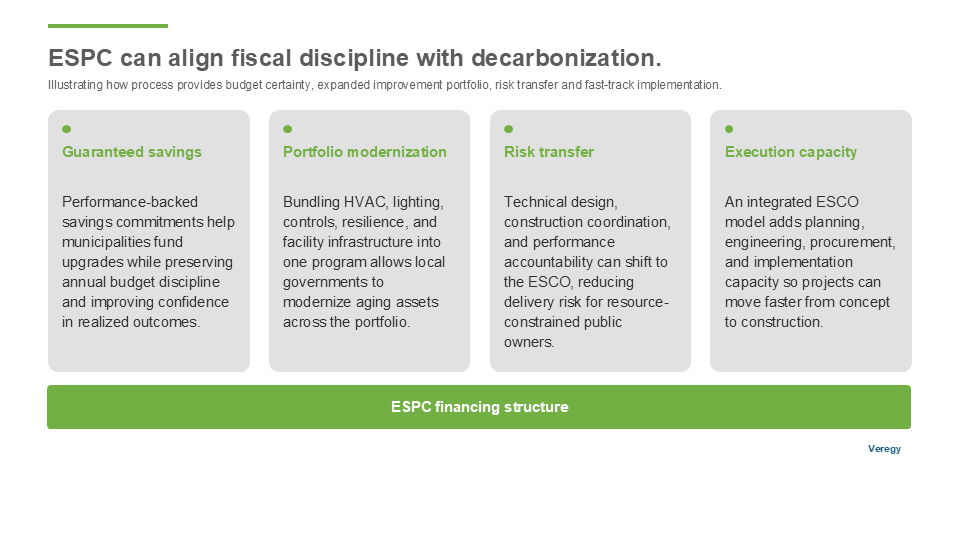
Traditional capital planning often fragments energy and decarbonization projects into separate line items: lighting in one year, HVAC in another, solar only if grant funding appears, controls later, and resilience measures only after a major failure. That sequencing can reduce near-term budget pressure, but it often destroys the economics of deep decarbonization because it leaves high-value synergies unrealized.
Three structural constraints tend to drive this outcome:
- Annual appropriations favor short-payback replacements over integrated modernization, even when the latter creates better lifecycle value.
- Departments manage their own priorities, so energy, facilities, fleet, and sustainability investments are rarely optimized as one portfolio.
- Public entities frequently carry significant deferred maintenance, which forces leadership teams to focus on equipment failure and service continuity before emissions reduction.
The result is familiar: local governments remain trapped in an incremental model that replaces failed assets but rarely reconfigures buildings and infrastructure for lower-carbon operations.
Exhibit C
How ESPC Changes the Investment Equation
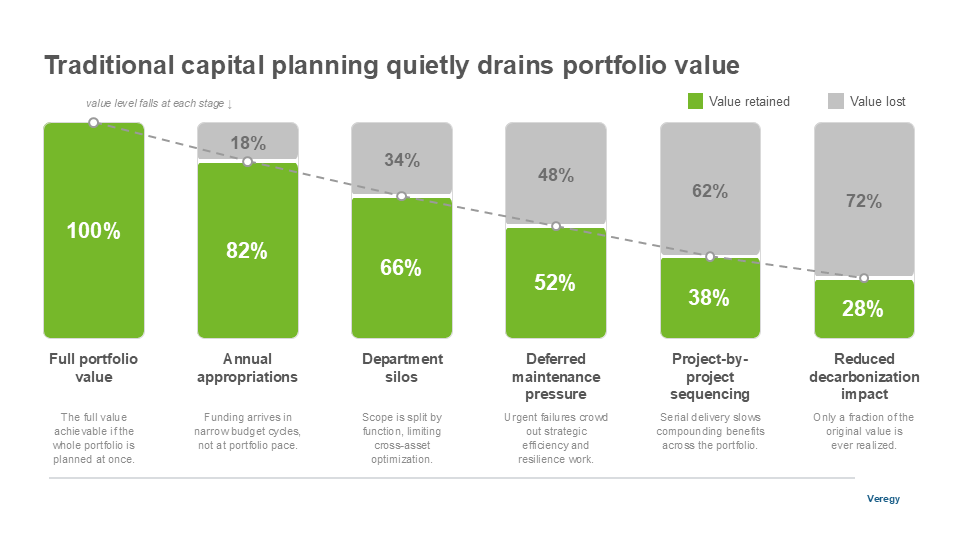
ESPC changes the decision logic from “What can be funded this year?” to “What package of measures can self-fund over time under a guaranteed savings structure?”
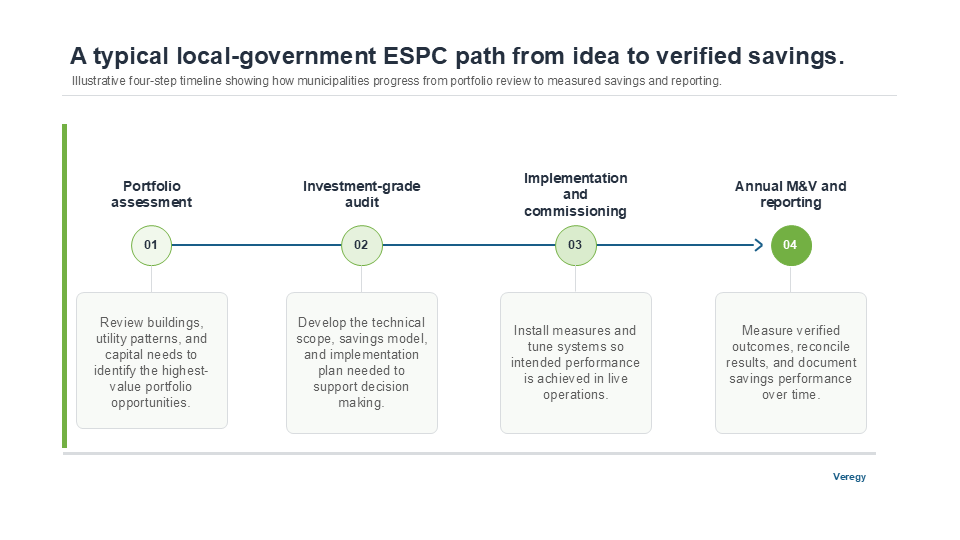
Under this model, the ESCO typically performs an investment-grade audit, develops a package of energy conservation measures, arranges or supports project financing, implements the work, and contractually guarantees a minimum level of savings. 2 If actual, measured savings fall below the guarantee, the ESCO is contractually required to make the owner whole for the shortfall.
This creates three advantages that are especially relevant to local government decarbonization:
- First, it allows comprehensive scope, because short-payback efficiency measures can support longer-payback clean energy and electrification measures within the same contract.
- Second, it accelerates timing, because projects can move without waiting for full upfront appropriations or voter-approved debt in every case.
- Third, it reallocates risk, the ESCO assumes a contractual obligation tied to performance, not merely delivering equipment.
In effect, ESPC transforms energy waste into investable cash flow and uses that cash flow to fund infrastructure that is cleaner, more reliable, and often easier to operate.
Exhibit D

The Strategic Role of Bundling
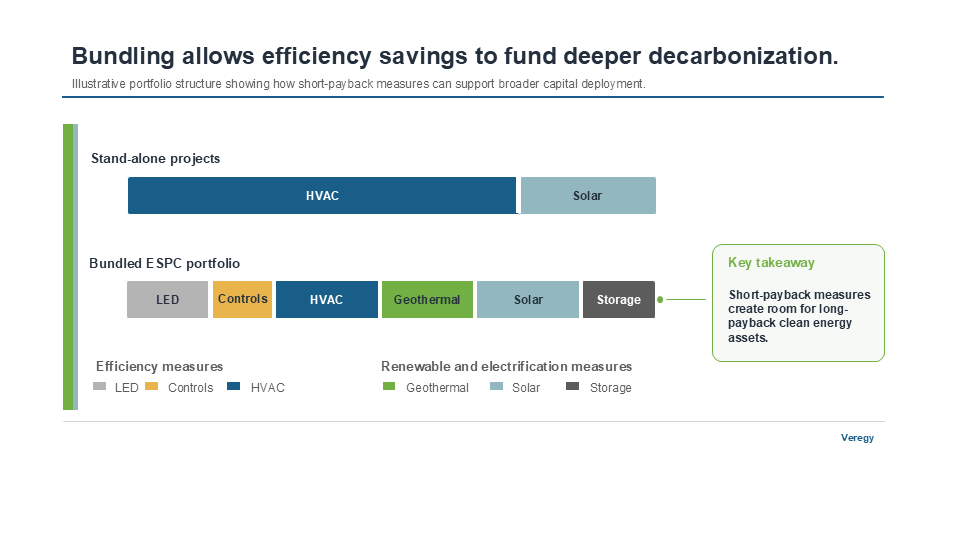
The economics of decarbonization improve materially when measures are bundled rather than pursued individually. This is one of the most underappreciated strengths of ESPC.
A standalone geothermal conversion, solar deployment, or storage project may appear difficult to justify on simple payback. But when these measures are paired with LED lighting, advanced controls, retro-commissioning, water savings, and high-efficiency HVAC replacements, the portfolio can generate enough near-term savings to support a broader capital scope.
This bundling logic matters because deep emissions reduction rarely comes from a single technology. It comes from combining demand reduction, system optimization, fuel switching, and cleaner supply. ESPC is one of the few public-sector delivery models explicitly designed to assemble that combination into a financeable package.
Exhibit E
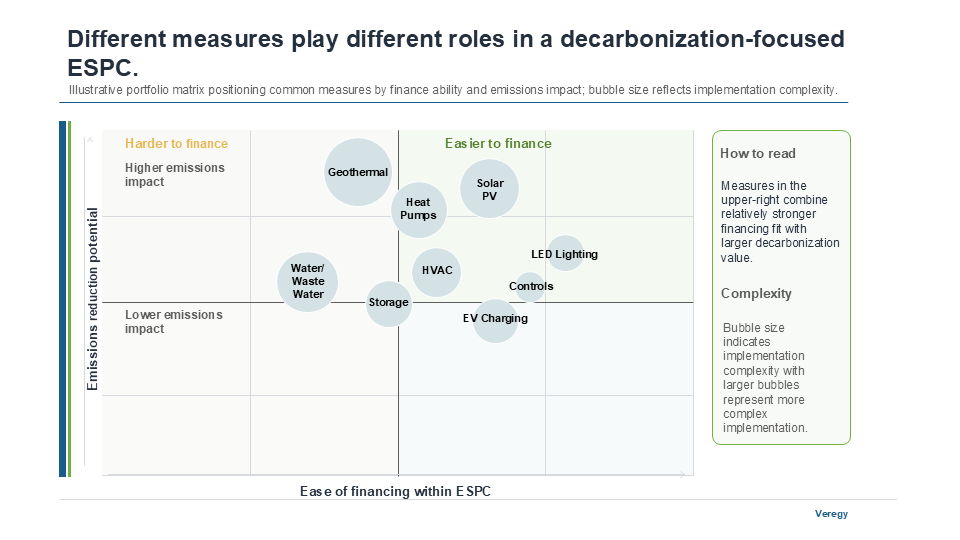
What Local Governments Can Include in a Decarbonization-Focused ESPC
The typical decarbonization-oriented ESPC extends well beyond lighting retrofits. Depending on state rules, site conditions and procurement strategy, the project scope can include a broad mix of measures.
The strategic question is not which single measure has the shortest payback. The better question is which portfolio best meets fiscal constraints while materially reducing emissions, maintenance exposure, and operational risk.
Table 1: Decarbonization measure examples
Measure |
Primary Value Creation |
Decarbonization Relevance |
Typical Strategic Role |
LED Lighting and Controls |
Immediate electric savings and reduced maintenance | Reduces grid electricity consumption and peak demand | Often strengthens early cash flow for the full bundle |
Advanced Building Automation |
Optimizes schedules, setpoints, and system interaction | Lowers wasted runtime and supports persistence of savings | Serves as the operating platform for broader modernization |
High-Efficiency HVAC and Heat Pumps |
Reduces consumption and addresses aging assets | Enables building electrification and lower combustion emissions | Often paired with controls and envelope improvements |
Geothermal Systems |
Delivers efficient heating and cooling over long asset lives | Can materially reduce emissions by shifting away from fossil-fuel-based heating and cooling | Best suited to sites with stable load profiles and long-term ownership |
Solar PV |
Offsets purchased electricity with on-site renewable generation | Directly lowers Scope 2 emissions from municipal operations | Frequently added once efficiency has reduced the underlying load |
Battery Storage |
Improves resilience and can reduce demand charges | Supports higher renewable penetration and critical-operations continuity | Most compelling where resilience or tariff optimization matters |
EV Charging Infrastructure |
Supports municipal fleet transition and public access goals | Reduces transportation emissions when paired with electrification | Often included where local governments have fleet and public-facing objectives |
Water and Wastewater Upgrades |
Improves performance in high-load process environments | Delivers sizable energy and emissions reductions in utility-intensive assets | Often high-value for counties and municipalities with utility operations |
Exhibit F
City of Mission, Kansas (Performance Contract Project with Veregy)
A variety of improvements to city facilities and infrastructure not only improve indoor health and comfort for patrons and occupants but also reduce the city’s energy and operational costs while minimizing the carbon footprint on the environment. Bipolar ionization technology at Powell Community Center improves the indoor air quality while boiler and chiller plant upgrades are major factors in reduced energy consumption and comfort. The Public Works Department and City Hall/Police Station also received major upgrades in HVAC, building envelope, and controls.
Project Energy Conservation Measures (ECM)Lighting & Lighting Controls Mechanical System Upgrades Destratification Fans Pool Smart Pump Controller and VFD Hypochlorite Generator Weatherization Wi-Fi Thermostat Control LED Street Light Upgrade LED Traffic Light Retrofit
|
Annual Energy Reduction: $102,456Powell Community Center: 28% Public Works: 17% City Hall-Fire Station: 17% Street and Traffic Lights: 36% kWh: 1,290,097 kW Demand Savings: 1,584.7 Natural Gas Therms: 24,988
|
Financing: The Real Bottleneck and the Hidden Opportunity
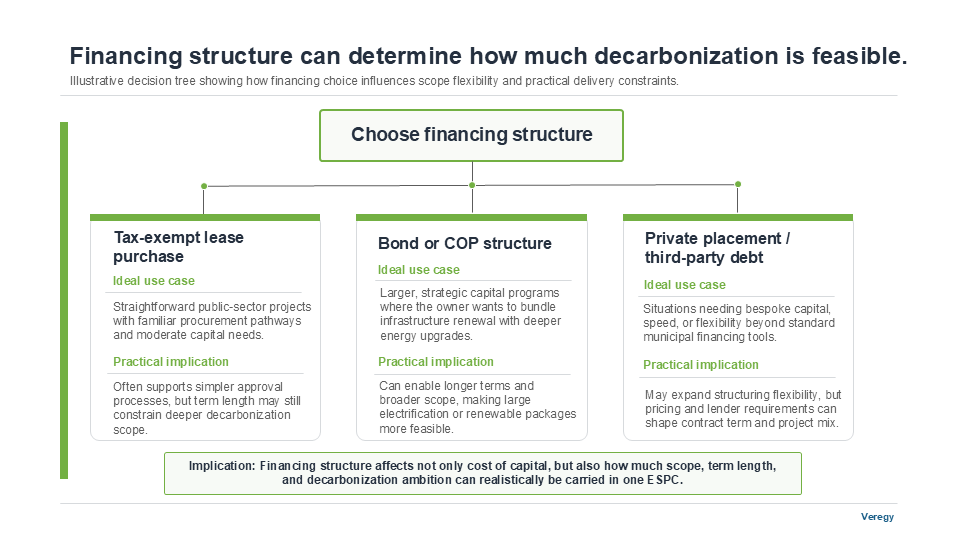
Most local-government climate plans underestimate how central financing design is to decarbonization outcomes. Project economics are shaped not only by equipment selection but by capital structure, contract term, treatment of avoided maintenance, and the owner’s willingness to aggregate measures across facilities.
ESPC financing is flexible. Common structures include tax-exempt lease-purchase agreements, municipal leases, privately placed debt, and in some cases, bond-backed or appropriation-backed structures. 3 The unifying principle is that annual repayment is set at or below the guaranteed savings stream, and with contract terms often ranging from roughly 10 to 25 years depending on project mix and state rules. 4
That flexibility has an important strategic effect; it allows leadership teams to optimize for lifecycle value rather than lowest first cost. For decarbonization, that is often the difference between replacing equipment like-for-like and fundamentally redesigning the energy system of a building or campus.
Exhibit G
Why the IRA changed The Economics
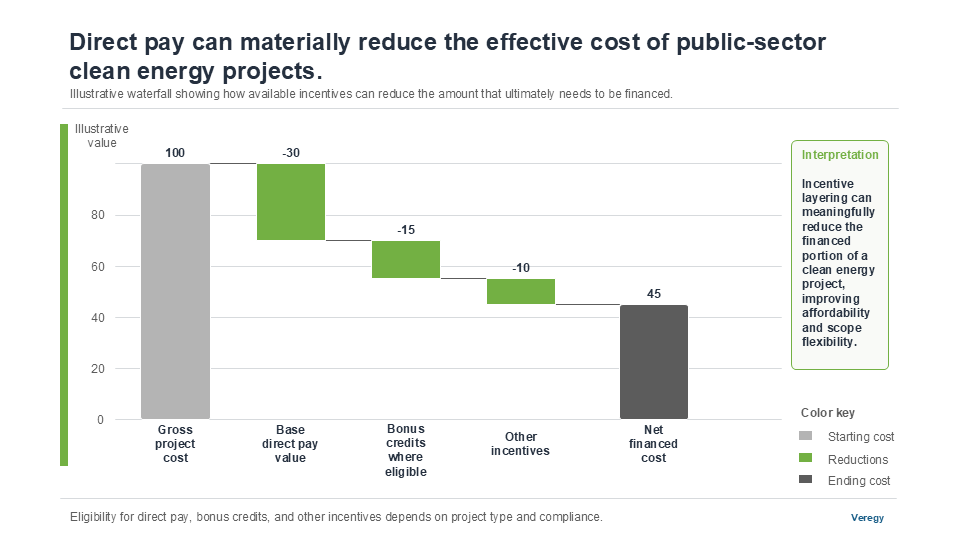
The Inflation Reduction Act materially improved the case for public-sector clean energy by allowing tax-exempt entities, including local governments, to access certain clean energy tax credits through direct pay, also known as elective pay. 5
For public owners, that change is consequential. Historically, cities and counties could not directly capture the value of tax credits in the way private investors could. Under the IRA, qualifying public entities can receive direct cash value for eligible credits tied to technologies such as solar, storage, geothermal, and certain EV charging infrastructure, subject to federal rules and documentation requirements. 6
The practical implication is significant. Historically, cities and counties could not directly capture the value of investment tax credits the way private investors could. Under direct pay, that barrier is removed for qualifying projects. 7 The result is that more projects now clear the financing hurdle, and projects that already made financial sense can often support broader scope, creating room for additional measures such as storage, electrification, and resilience upgrades.
Exhibit H
Why ESPC and IRA are Stronger TOgether
Exhibit I
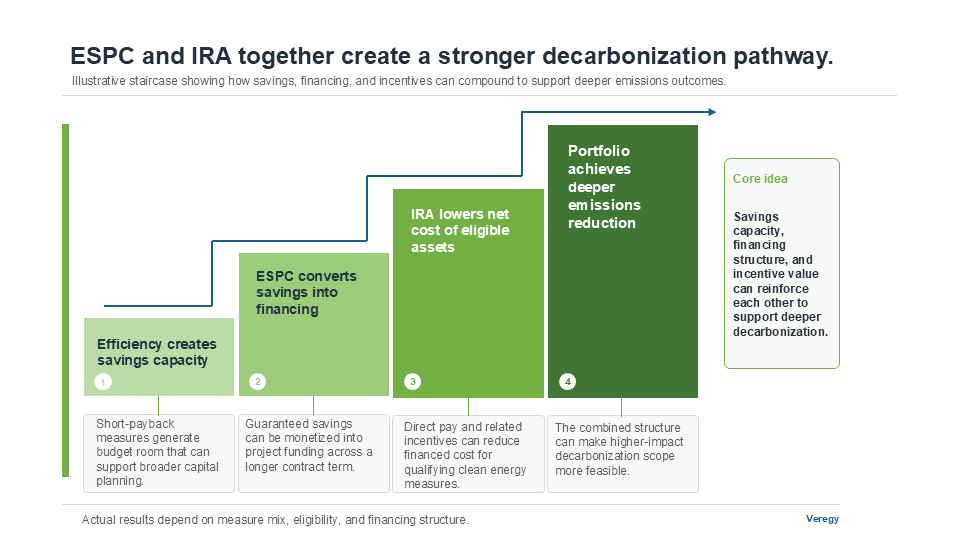
The combined effect of ESPC and IRA is more powerful than either tool on its own. ESPC solves the execution and repayment challenge by converting savings into a project-financing mechanism. IRA improves the economics of qualifying clean energy assets by reducing effective project cost for eligible public owners. 8
Together, they make it easier for a local government to move from an “efficiency-only” project to a broader modernization effort that can include on-site generation, thermal decarbonization, and resilience. In many cases, that means the public owner is no longer forced to choose between fixing old equipment and investing in lower-carbon infrastructure; both can happen in the same program.
A useful way to think about this is through the hierarchy of public-sector investment decisions:
- Efficiency reduces waste and creates savings capacity.
- Financing structures those savings into a predictable repayment model.
- IRA incentives lower the net cost of eligible clean energy assets.
- The resulting portfolio can deliver deeper emissions reduction with stronger budget outcomes.
The Guarantee: Why the Model is Credible
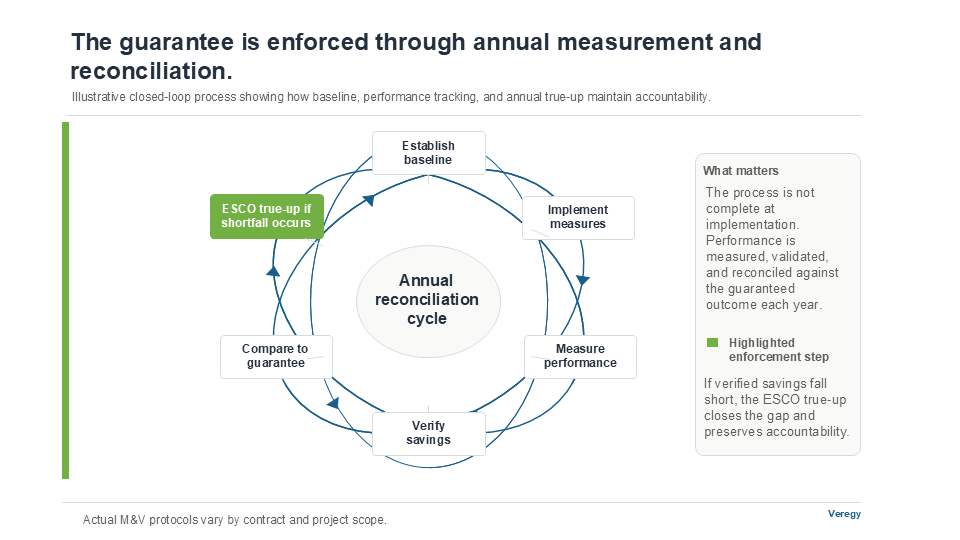
A decarbonization strategy is only as credible as its performance discipline. This is where the ESPC savings guarantee matters most. A robust guarantee does not simply promise that utility bills should trend downward. It defines baseline conditions, identifies which savings streams count toward the guarantee, establishes the measurement and verification methodology, and specifies how adjustments will be handled when variables such as weather, occupancy, or operating hours change materially.
If verified savings fall below the guaranteed level, the ESCO is contractually obligated to pay the difference or otherwise remedy the shortfall, depending on contract terms. That structure is especially important for local governments because it provides a degree of budget protection that conventional capital projects typically do not offer. Finance officers are not being asked to trust an engineering estimate. They are being asked to evaluate a contract in which the provider stands behind a defined performance outcome.
Exhibit J
What Gets Guaranteed
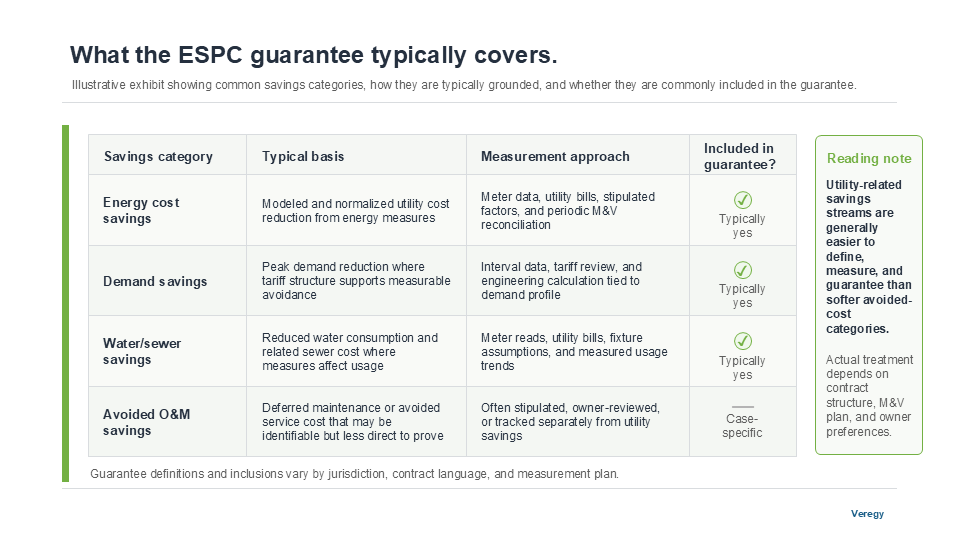
In most cases, the guarantee is expressed in annual dollar savings derived from measured reductions in energy use and, where appropriate, water and maintenance costs. Some contracts track physical units such as kilowatt-hours, therms, or gallons and convert them into monetary savings using agreed utility rates and formulas.
Well-structured contracts typically rely on recognized protocols such as IPMVP, along with explicit treatment of baseline assumptions and any allowed adjustments. 9 This is not administrative detail; it is the mechanism that turns engineering projections into enforceable commercial commitments.
Exhibit K
The Operating Model Matters as Much as the Technology
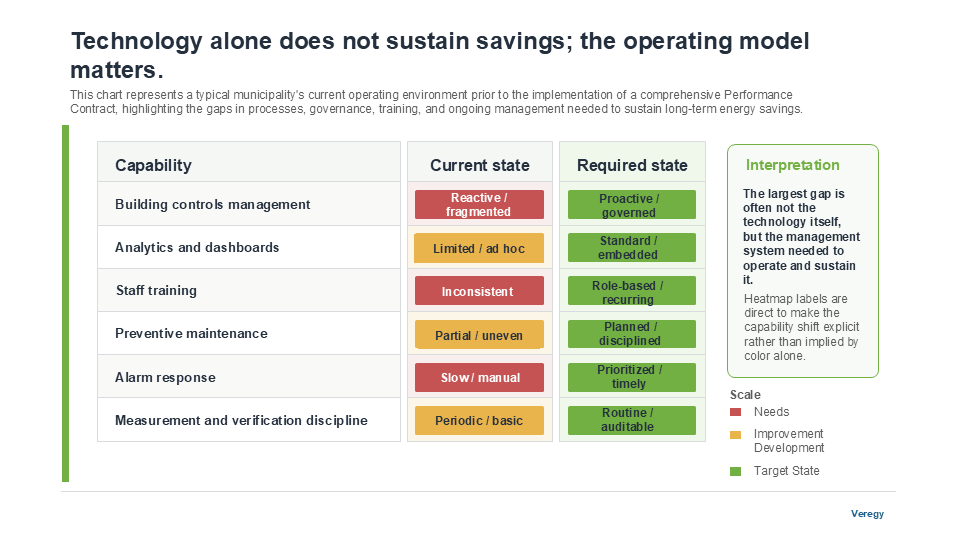
One reason public-sector decarbonization projects underperform is that owners sometimes treat implementation as the finish line. In reality, a modernized facility portfolio requires a stronger operating model, not just better equipment.
Advanced controls must be monitored, schedules adjusted, alarms acted upon, and building staff trained to maintain performance over time. Heat pumps and geothermal systems require different operational familiarity than legacy fossil-fuel equipment. Solar and storage create additional value only when dispatch logic, tariff interaction, and resilience protocols are well understood.
The value of ESPC is that it can integrate these operational considerations into a longer-term accountability structure rather than leaving them as an afterthought after construction closes out.
Exhibit L
Where Local Governments Should Start
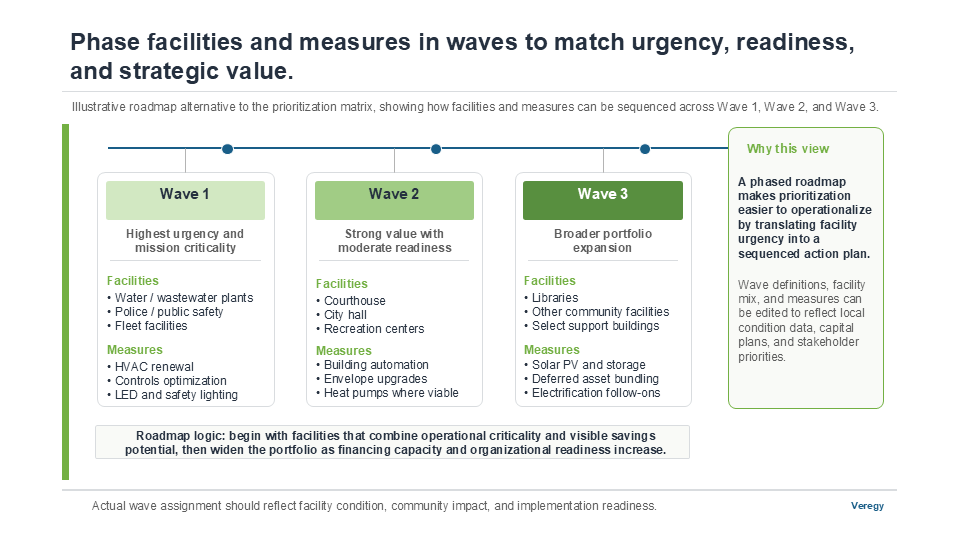
The right starting point is usually not a single building. It is a portfolio assessment anchored in three questions:
- Which facilities have the highest combination of energy intensity, deferred maintenance, and strategic importance?
- Which measures create the largest pool of dependable savings that can support broader decarbonization scope?
- Which sites and technologies are best positioned to benefit from direct pay and other available incentives?
This portfolio view is important because the best decarbonization project is not necessarily the site with the best engineering case in isolation. It is the investment package that best balances speed, savings, carbon reduction, resilience, and political feasibility across the public owner’s footprint. 10
City of Collinsville, Illinois (Aqua Park Facility Performance Contract Project WIth Veregy)
The project goals were to renew the facility’s façade, pools, locker rooms, and offices; lower the long term operational and maintenance costs; reduce the facility’s consumption of energy and water; and enhance the quality of the facility. Energy Savings in Water, HVAC, Solar, and Lighting.
“The City of Collinsville is delighted with the upgrades and improvements at the Aqua Park and Activity Center. Not only is the appearance of the park greatly improved, but the efficiency the improvements have made will provide our residents savings for years to come.”
Kimberly Caughran, Director of Parks & Recreation
Exhibit M
What Separates Leaders From Followers
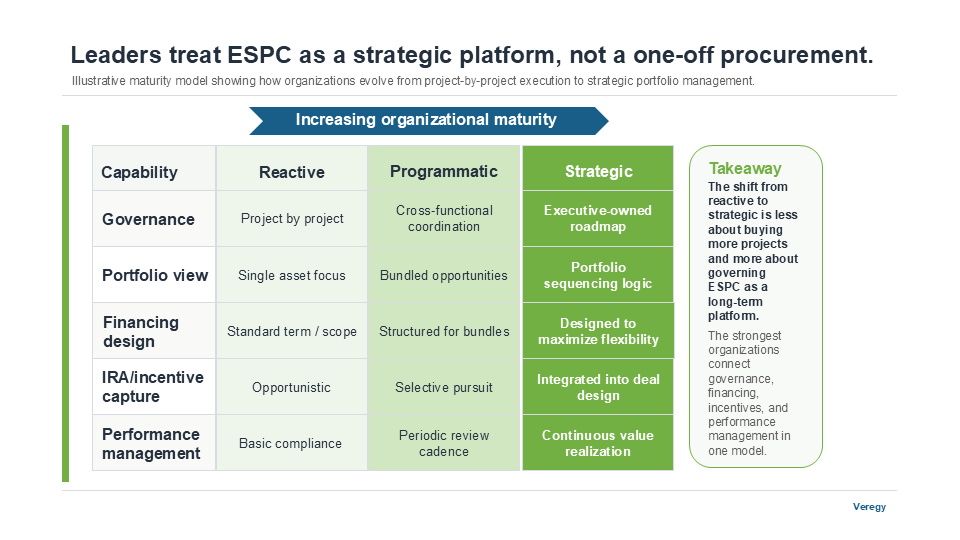
The highest-performing local governments tend to approach ESPC as a strategic platform rather than a procurement tactic. They do four things differently:
- They link decarbonization targets directly to capital planning and facilities strategy, rather than running sustainability as a separate agenda.
- They bundle measures to maximize portfolio economics instead of selecting projects purely on simple payback.
- They design financing and incentive capture early, including IRA eligibility and compliance, rather than treating incentives as an add-on after scope is set.
- They treat measurement, verification, and operational follow-through as core management disciplines, not closing paperwork.
This is ultimately why ESPC deserves more attention in local-government thought leadership. It is not merely a way to replace old equipment. It is a mechanism for solving the institutional barriers that routinely prevent public-sector decarbonization from moving at the pace leaders say they want.
Exhibit N
The Implications for Local-Government Leadership
For elected officials, city managers, finance directors, and public works leaders, the question is no longer whether cost-effective decarbonization technologies exist. They do. The more consequential question is which delivery model can translate those opportunities into funded, executed, and verified outcomes. 11
ESPC increasingly stands out because it aligns four objectives that local governments usually struggle to satisfy simultaneously: infrastructure renewal, emissions reduction, budget protection, and execution accountability. 12
That alignment is the core strategic point. When structured well, performance contracting gives local governments a credible path to cut energy use, lower maintenance exposure, modernize public assets, and advance decarbonization without forcing a trade-off between climate ambition and fiscal prudence.
Exhibit O
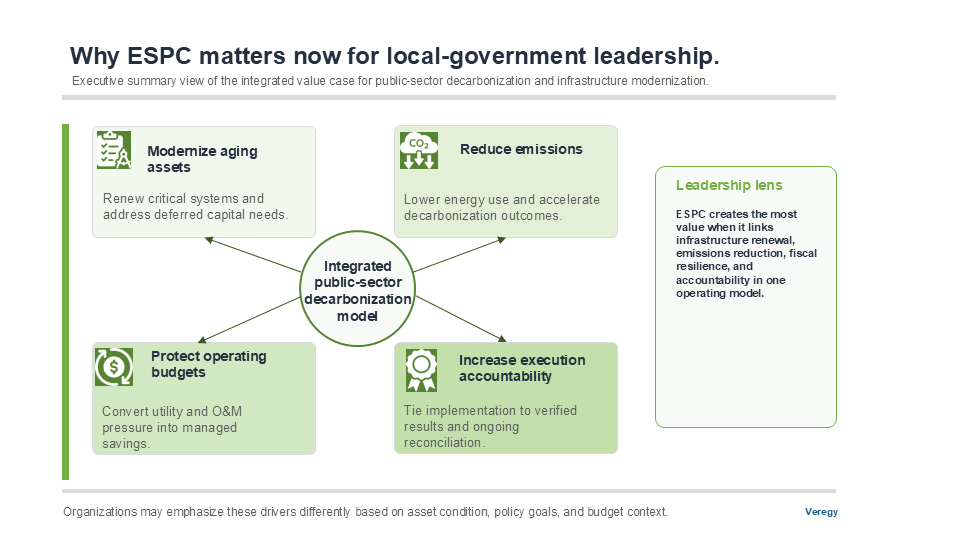
Exhibit P
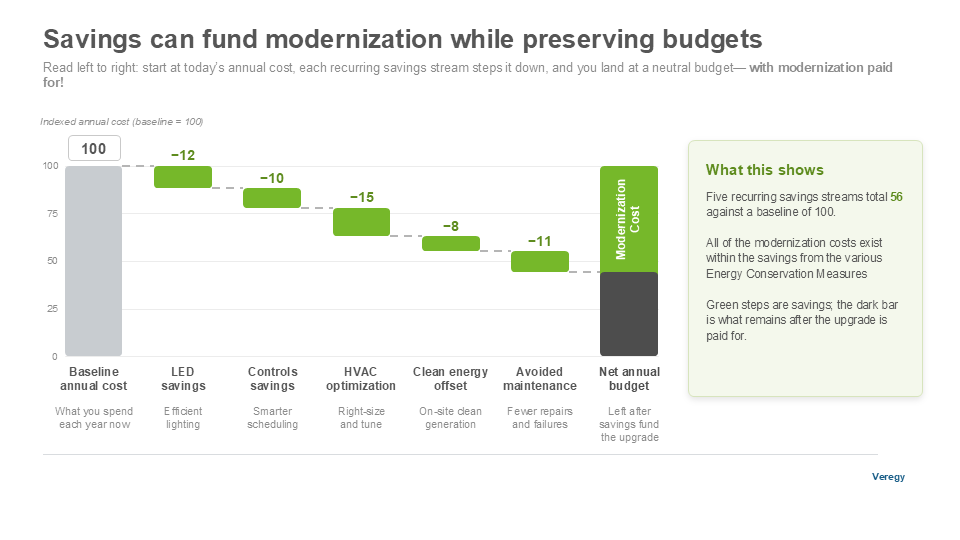
Exhibit Q
References
- U.S. Department of Energy, Federal Energy Management Program. “Performance Contracting National Resource Center.” Last updated March 31, 2025.
https://www.energy.gov/femp/performance-contracting-national-resource-center - U.S. Department of Energy, Federal Energy Management Program. Understanding Your ESPC Savings Guarantee. 2019.
https://www.energy.gov/sites/prod/files/2019-02/f59/understanding-espc-savings-guarantee.pdf - U.S. Department of Energy, Better Buildings Financing Navigator. “Energy Savings Performance Contract — Financing Option.” August 22, 2023.
https://betterbuildingssolutioncenter.energy.gov/financing-navigator/option/espc-financing - U.S. Congressional Research Service. Energy Savings Performance Contracts (ESPCs) and Utility Energy Service Contracts (UESCs): Federal Agency Implementation and Oversight. Report R45411. November 22, 2018.
https://www.everycrsreport.com/reports/R45411.html - National League of Cities. “How Local Governments Can Use Direct Pay on Clean Energy Projects.” December 21, 2022.
https://www.nlc.org/article/2022/12/22/how-local-governments-can-use-direct-pay-on-clean-energy-projects/ - U.S. Environmental Protection Agency. “Summary of Inflation Reduction Act Provisions Related to Renewable Energy.” Last updated July 28, 2025.
https://www.epa.gov/green-power-markets/summary-inflation-reduction-act-provisions-related-renewable-energy - National Association of Counties. “Energy Efficiency and Performance Contracting.” Accessed May 2026.
https://www.naco.org/resources/featured/energy-efficiency-and-performance-contracting - RMI and Local Infrastructure Hub. A Roadmap for Maximizing Inflation Reduction Act Opportunities for Cities. 2023.
https://cityrenewables.org/wp-content/uploads/edd/2023/10/local-infrastructure-hub-ira-roadmap-for-cities.pdf - Energy Efficiency Partnership of North Carolina. Energy Savings Performance Contracting: Best Practices from the Experts. 2019.
https://eepartnership.org/wp-content/uploads/2019/09/ESPC-from-the-Experts.pdf - RMI and Local Infrastructure Hub. A Roadmap for Maximizing Inflation Reduction Act Opportunities for Cities. 2023. See note 8.
https://cityrenewables.org/wp-content/uploads/edd/2023/10/local-infrastructure-hub-ira-roadmap-for-cities.pdf - U.S. Environmental Protection Agency. “Performance Contracting and Energy Service Agreements.” Last modified February 11, 2026.
https://www.epa.gov/statelocalenergy/performance-contracting-and-energy-service-agreements - Bricker & Eckler LLP. “Key Incentives Available Under the IRA for Local Governments Investing in Clean Energy.”
https://www.brickergraydon.com/insights/resources/key-incentives-available-under-the-ira-for-local-governments-investing-in-clean-energy
FAQs
- What is Energy Savings Performance Contracting (ESPC)?
ESPC is a project delivery and financing model that uses guaranteed energy, water, and maintenance savings to pay for facility and infrastructure upgrades over time. It helps local governments move forward on modernization without relying entirely on new appropriations, grants, or tax increases. - Why is ESPC relevant to local government decarbonization?
The article’s core point is that most public entities do not lack viable technologies; they struggle with capital allocation and execution. ESPC addresses both by packaging improvements into a financeable program with contractual performance accountability. - How is ESPC different from traditional capital planning?
Traditional planning often funds projects one item at a time, which can weaken project economics and delay deeper carbon reduction. ESPC allows agencies to evaluate a broader package of measures that can self-fund under a guaranteed savings structure. - What types of improvements can be included in an ESPC?
A decarbonization-focused ESPC can include more than lighting upgrades. The article highlights options such as building automation, high-efficiency HVAC, heat pumps, geothermal, solar PV, battery storage, EV charging, and water or wastewater improvements. - Why does bundling matter so much?
Bundling helps short-payback measures support longer-payback investments within one program. That approach can make deeper decarbonization more financially practical than pursuing each measure as a standalone project. - How are ESPC projects typically financed?
The article notes that ESPC financing can take several forms, including tax-exempt lease-purchase agreements, municipal leases, and other public-sector financing structures. The key principle is that annual repayment is aligned with the guaranteed savings stream. - What role does the Inflation Reduction Act play?
The Inflation Reduction Act improved economics for qualifying public-sector clean energy projects by allowing certain tax-exempt entities to access eligible incentives through direct pay. That can reduce net project cost and make broader project scopes easier to justify. - Why are ESPC and IRA incentives so effective together?
ESPC helps solve project delivery, financing, and repayment, while IRA incentives can lower the effective cost of eligible clean energy assets. Together, they can help local governments modernize infrastructure and reduce emissions without forcing a trade-off between fiscal discipline and climate progress. - How does the savings guarantee protect public owners?
A well-structured guarantee defines baselines, measurement methods, eligible savings streams, and adjustment rules. If verified savings fall short, the ESCO is typically required to make up for the difference or otherwise resolve the shortfall under the contract. - Where should a local government begin?
The article recommends starting with a portfolio-wide view rather than a single building. Leaders should assess which facilities offer the best mix of energy savings potential, deferred maintenance need, strategic value, and incentive eligibility.